Doug's Leadership Priorities

The plan Doug has developed is based on what he has heard while speaking with hundreds of Colwood residents throughout his term concerning the issues and challenges that are top of mind. And he knows that it will take mayor and council working as a team to deliver on these priorities.

If re-elected Mayor, Doug Kobayashi's priorities are clear and connected, with a mission to lead the delivery of a healthy, vibrant, and sustainable community for the people of Colwood.

What Doug has been hearing from the people

Residents love living in Colwood because of its proximity to nature, the seaside, and its safe neighbourhoods. Most people can see that this community is growing at an unprecedented rate and now facing more complex urban issues. Meeting those challenges requires vision, leadership, experience, and the courage to make tough decisions.

Doug will continue to use his experience and skills to clearly define problems and listen carefully with objectivity to bring opposing interests together to find common solutions that best serve the people of Colwood and the broader West Shore.

"I promise you that I will work hard to maintain and grow your trust as we work together and continue to build a strong, healthy, and safe community with a Council that listens to the people who elected them," said Doug.

Kobayashi's plan illustrates clear priorities that are all connected. For Colwood to reach its potential, council must continue to find collaborative ways to achieve these important goals.

Please read on to learn about Doug's plan for the next four years, which is grounded by strong leadership and dedicated to smart growth that will support and sustain a better Colwood.
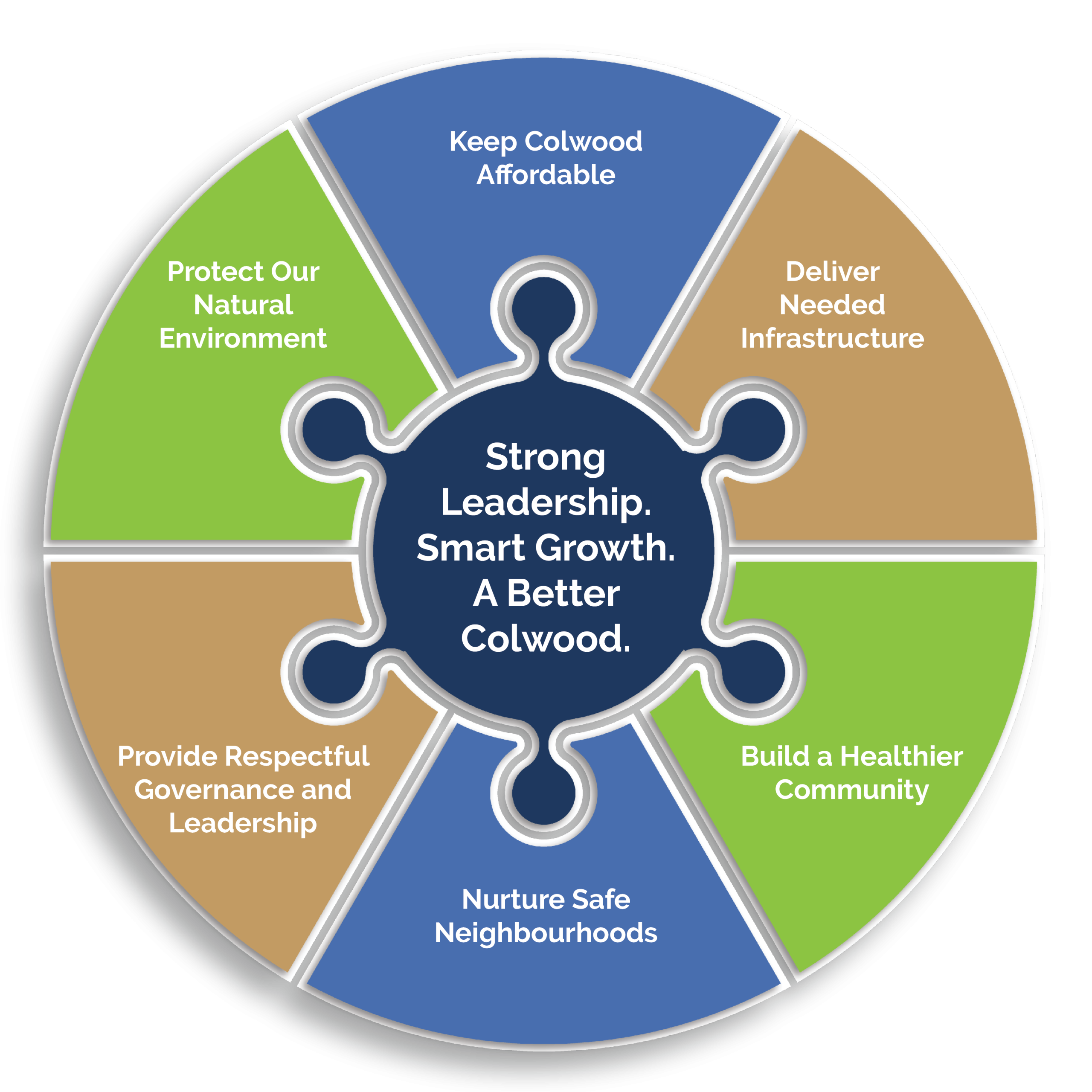
The infographic above breaks down how Doug plans to approach the next council term, if re-elected. It’s based on continuing to lean in, listen, and deliver for the Colwood community utilizing his decades of combined experience as an elected official, military leader, corporate executive, local small business owner and community volunteer.

Mission Oriented

Breaking Down the Plan

Keep Colwood Affordable

Protecting taxpayers while building a financially sustainable future.

Keep property taxes affordable (Colwood's property taxes have been the lowest in the CRD for the past 4 years).

The "right sizing" of core services means tailoring municipal operations, rather than automatically expanding city departments as the population grows. During this term, our council reduced city hall bureaucracy in order to save taxpayers money, in the same way many people in our community have been needing to tighten their belts. Colwood now conducts service reviews to ensure staffing, equipment, and budgets match the actual operational needs of our community – neither over-funding nor under-funding services … “the right size”.

Putting Our Core Priorities First: Municipal spending needs to remain strictly focused on essential local responsibilities (roads, sewers, fire protection, park maintenance, and waste management) rather than non-essential or duplicative programs.

Maintaining a Focus on Operational Efficiency: It's important for our municipality to look for ways to streamline city processes and reallocate existing resources before adding new ongoing operational costs to the municipal budget.

Residential property owners historically bear the brunt of municipal property taxes. By working to attract commercial, retail, and industrial businesses to Colwood, we can shift more of the tax load onto non-residential properties.

Smart Growth & Local Jobs: Encouraging commercial developments (such as The Beachlands or Colwood Corners) creates local employment and services, keeping tax revenues inside the community without overburdening existing neighborhoods.

Balanced Zoning: Colwood can also grow our tax base by approving developments that generate long-term tax revenue relative to the cost of the municipal services they require.

Capital projects (like major road upgrades, waterfront developments, or sewer extensions) should be financed through development contributions, senior government grants, and dedicated reserve funds rather than high-risk, long-term municipal debt.

Life-Cycle Asset Management principles should factor prominently in our planning. Infrastructure built today must include long-term maintenance plans. Future taxpayers shouldn't be left with a "deferred maintenance deficit" or decaying assets they cannot afford to repair.

Sharing costs fairly over time: New facilities should be paid for by the generations who benefit from them, rather than leaving future Colwood residents to pay the bill for past decisions.

Deliver Needed Infrastructure

Ensuring growth pays its way and services keep pace with our community.

Growth must pay for growth. Core services and infrastructure must keep up with growth.

As Colwood grows, municipal services (sewer systems, road capacity, sidewalks, transit hubs, and emergency services like fire and policing) must expand concurrently. Building housing without expanding core utilities leads to traffic congestion, overloaded sewers, and degraded municipal services.

Development Cost Charges (DCCs) and Amenity Contributions on new residential and commercial real estate developments should fund the capital projects they necessitate—such as new roads, sewer expansions, and parks, rather than funding them through property tax increases on our current residents.

In Colwood (one of Greater Victoria's fastest-growing West Shore communities) this policy balances provincial demands for increased housing supply with local demands to prevent tax spikes and maintain community livability.

Expanding municipal infrastructure like parkland, community centres, arts and cultural spaces, and public washrooms, belongs in part to the developers building the new housing supply, ensuring existing homeowners aren't subsidizing private development.

Build a Healthier Community

Expanding care, connection, and support so every Colwoodian can thrive.

Continue to expand our municipal primary care clinic model until every Colwoodian has a family doctor.

In response to severe doctor shortages across the West Shore, Colwood launched a first-in-Canada municipal clinic model. Under this framework, the city hires family physicians as municipal employees, offering them guaranteed salaries, benefits, and municipal pensions while managing clinic administrative overhead. Kobayashi’s leadership promises to scale up this municipal employer model to recruit and retain additional physicians until every resident on the provincial Health Connect Registry in Colwood is matched with a dedicated family doctor.

Healthcare delivery and mental health funding fall under provincial jurisdiction (BC Ministry of Health and Island Health), but local governments influence the baseline conditions for health through urban planning, active transportation, park infrastructure, and local advocacy. Kobayashi intends to leverage city-provincial partnerships to secure provincial funding for local mental health resources, align city land-use planning with wellness infrastructure, and maintain direct collaboration with regional health authorities.

The Village Initiative is a collective impact network of over 70 organizations (including Island Health, the Sooke School District SD62, and non-profit service providers) operating across the West Shore and Sooke. It focuses on sharing physical space, pooling resources, and eliminating silos to streamline access to youth programming, family counselling, and social supports. Kobayashi continues to support resource-sharing with the network to ensure Colwood’s rapidly growing population of young families has direct coordinated access to social and community services

Nurture Safe Neighbourhoods

Creating safer streets, stronger emergency readiness, and proactive community safety.

Continue to implement safer street initiatives (traffic safety, road safety, traffic calming, speed limits, etc.)

Colwood’s rapid residential growth, particularly along arterial routes like Metchosin Road and Wishart Road, has brought increased traffic volumes, driver speeds, and safety concerns near school zones and pedestrian crosswalks. Kobayashi is promising continued investment in physical traffic-calming infrastructure (such as speed humps, raised crosswalks, curb extensions, and narrowed lanes), lowering speed limits in targeted residential areas, and prioritizing pedestrian/cyclist safety in municipal transit and street improvement plans.

Colwood is policed by the West Shore RCMP detachment, a joint service shared with neighboring municipalities. The city faces growing operational demands that require expanding police facility infrastructure and personnel budgets. "Upstream" crime prevention refers to initiatives (like Colwood’s participation in Federal Building Safer Communities funding and Project UPSTREAM) that address the root causes of crime through youth engagement, social programs, and mental health interventions before incidents occur.

Kobayashi commits to funding the necessary police staffing and facility needs required as Colwood grows, while balancing those investments with community-based social interventions designed to keep youth out of the justice system.

Vancouver Island faces localized environmental risks, including wildfire hazards at the urban-wildland interface, severe storms, atmospheric rivers, and long-term earthquake risks (the "Big One"). Kobayashi promises to strengthen Colwood’s municipal emergency management plans, improve early-warning communications (such as the Colwood Alert system), stock neighborhood response supplies, and enhance collaboration between the Colwood Fire Rescue, West Shore RCMP, and local volunteer emergency networks.

Protect Our Natural Environment

Balancing responsible growth with the natural beauty that defines Colwood.

Continue a commitment to ensuring Colwood’s growth is balanced with environmental stewardship. Growth should never come at the expense of what makes our community beautiful.

Colwood is experiencing rapid residential development (such as the master-planned communities at Royal Bay and The Beachlands). Balancing this expansion with the preservation of natural assets (like coastal Douglas-fir ecosystems, urban tree canopies, and sensitive marine habitats) is a central issue for residents. Kobayashi promises to use municipal tools (like updated Official Community Plan policies, tree protection bylaws, and strict environmental impact assessments) to ensure new developments contribute positively to local infrastructure without degrading the city's natural scenery, waterfront access, or green spaces.

Local grassroots groups drive much of Colwood’s ground-level conservation and neighborhood efforts - organizing invasive plant pulls (e.g., removing broom and ivy in municipal parks), running community gardens, and hosting zero-waste initiatives. Kobayashi pledges ongoing municipal support (via civic grants, program collaborations, access to public land, material supplies, and city communications) to keep these volunteer groups funded and operational as key partners in city maintenance and sustainability.

Colwood is partnering with Parks Canada, local First Nations, and regional stakeholders on a proposed National Urban Park surrounding Fort Rodd Hill, Fisgard Lighthouse, and Coburg Peninsula. Concurrently, private master-planned developments include mandatory public land transfers—such as the 47-acre park network dedication at The Beachlands and the expanding Quarry Park in Latoria South.

Kobayashi commits to securing federal designation and funding for the National Urban Park while partnering with major property developers to open dedicated parklands and trails to the public as new neighbourhoods are constructed.

Respectful Governance and Leadership

Delivering transparent, accountable leadership focused on results for residents.

Continue evidence-based decision-making that delivers the best bang for the taxpayer’s buck.

Local governance often faces criticism when decision-making occurs behind closed doors or project outcomes stall. Kobayashi’s campaign positions transparency and clear, measurable progress as foundational to maintaining public trust in City Hall. Kobayashi also promises open communication regarding municipal actions, public accountability for major civic decisions, and a council environment focused on completing key community projects rather than prolonged debates.

With municipal budgets strained by inflation, rising infrastructure costs, and rapid regional expansion, fiscal responsibility is a top concern for residents. Kobayashi (who brings a background in executive leadership, business management and engineering) emphasizes using data and financial feasibility analyses rather than ideology to guide municipal spending.

Kobayashi also commits to rigorous cost-benefit reviews before allocating tax dollars, ensuring civic investments deliver clear, tangible returns while keeping municipal property tax increases as manageable as possible.

Context: As Colwood transitions from a small bedroom community into a larger more diverse suburban center (now approaching 24,000 residents) traditional municipal reporting methods can become outdated. Modern governance frameworks rely on Key Performance Indicators (KPIs) to track service delivery times, infrastructure upkeep, and customer service responsiveness. Kobayashi plans to maintain clear municipal benchmarks to evaluate city staff and council performance making city operations more responsive and adaptable to the needs of a growing, diverse populace.

Key issues like public transit, regional highway bottlenecks, emergency services, and social infrastructure extend beyond Colwood’s municipal boundaries. Colwood participates in regular West Shore leadership roundtables alongside neighboring municipalities (such as Langford, View Royal, Sooke, and Metchosin) and inter-agency committees focused on youth and family welfare.

Kobayashi highlights his commitment to regional diplomacy, pledging to work collaboratively with nearby mayors and cross-sector leadership teams to solve shared challenges like family service access, transportation, and public safety.

Under provincial legislation, B.C. municipalities are encouraged to adopt and regularly refine a formal Code of Conduct outlining standards of integrity, respect, and professional ethics for elected officials. In Colwood, adherence to and enforcement of these standards (including handling conduct reviews appropriately) remains an active point of public interest.

Kobayashi promises to maintain formal, enforceable standards for how members of council interact with each other, staff, and the public, aiming to prevent workplace misconduct, maintain institutional decorum, and ensure clear procedures are followed if conflicts or ethics violations arise.

The Capital Regional District

Representing Colwood taxpayers at the regional table

Serving as Director on the Capital Regional District (CRD) Board

Kobayashi represents the municipality as a Director on the CRD Board (the regional governing body responsible for broader infrastructure, wastewater treatment, regional parks, and environmental management across Greater Victoria). He leverages Colwood’s vote on regional governance to protect local taxpayer interests, ensure growth priorities are heard at the regional table, and advocate for fair regional cost-sharing on major capital projects.

The CRHD funds regional health infrastructure and facility expansions across southern Vancouver Island, partnering with Island Health to upgrade hospitals and outpatient care facilities. Kobayashi advocates for West Shore health funding, ensuring regional capital funds support localized health services, urgent primary care centres, and local care delivery to reduce pressure on Victoria General Hospital.

The CRHC is an arm’s-length entity owned by the CRD that develops and manages affordable social housing communities across the region. Kobayashi’s position allows him to direct regional housing grants and affordable development initiatives toward Colwood, supporting mixed-income housing options for workforce personnel, seniors, and young families in the West Shore.

Regional bottlenecks along the Highway 1/Galloping Goose corridors and transit connectivity affect West Shore commuters daily, requiring cross-jurisdictional advocacy between the CRD, BC Transit, and neighbouring municipalities. Kobayashi uses his regional platform to advocate for integrated transit corridors, multi-modal trail expansions, and coordinated road network planning so Colwood residents aren't trapped in regional commuter gridlock.

“Since being elected in 2022, I have made it a priority to listen carefully to the needs and concerns of Colwood residents and to reflect what I’ve heard in my decisions and actions. My previous four years on council, along with decades of experience as a military leader, corporate executive, small business owner, and community volunteer, helped me hit the ground running as mayor. I’m proud of what we’ve accomplished so far, and if re-elected, I’m mission-ready and eager to continue the important work underway.”

Doug Kobayashi

Like What You See? Get Involved with Doug's Campaign